
Blog
What AI Didn't Automate
Every few months someone asks me some version of the same question. If AI can write the code, run the analysis, and draft the report, what is actually left for me to be good at?
The honest answer is that the work didn't disappear. It moved. Four things now matter more than they used to, not less, and none of them are about typing faster.
Theory still matters, AI just clears the repetitive part off your desk
I still need to understand why a regression assumption breaks, why a particular join produces duplicate rows, why a p-value means what it means and not what people wish it meant. No model reads that understanding into my head. What has changed is how much of the mechanical execution I have to do myself to prove I understand it.
Ten years ago, demonstrating you understood a statistical method meant writing the code by hand, debugging it, and running it. Now the coding part can be delegated. The understanding cannot. If you don't know what a false discovery rate correction is for, an AI agent will happily give you a broken analysis with a clean-looking output, and you will have no way to know it's broken. Theory is what lets you catch that. It was always the actual skill. Writing the loop yourself was just how you used to prove you had it.
Speed changes what "finished" means
The other shift is pace. A workflow that used to take a week of scripting, waiting, and re-running can now be drafted, tested, and iterated on in an afternoon. That is not a small efficiency gain. It changes what a reasonable turnaround time looks like, and it changes what counts as a first draft versus a finished product.
This cuts both ways. It's genuinely useful when the task is well-scoped and the cost of a wrong first attempt is low. It's a trap when speed becomes the point instead of a tool, because a fast wrong answer delivered on time is still wrong. The skill isn't "use AI to go faster." It's knowing which parts of a workflow benefit from that speed and which parts need to stay slow on purpose.
The scarce skill is now strategic, not mechanical
Here is the part I keep coming back to. When the mechanical execution gets cheap, the valuable work stops being how do I write this function and becomes why are we solving this problem, and what is the smallest set of steps that gets us there.
That's a different kind of thinking. It means being able to explain, in plain language, why a project matters before a single line of code exists. It means being able to sketch the high-level shape of a solution (three stages, not thirty) and trust that the detailed execution can follow once the shape is right. Strategy was always supposed to be the senior part of the job. AI just removed the excuse to hide from it inside busywork.
Writing is the interface, and most people are bad at it
This is the one people underrate the most. Talking to an AI well is a writing skill. A vague prompt gets a vague result. A prompt that states the goal, the constraints, and what a good answer looks like gets something you can actually use on the first try. That is not a prompt-engineering trick, it's the same skill that makes a brief clear to a colleague or a report clear to a decision-maker who has thirty seconds to read it.
I've noticed the people who get the most out of AI tools aren't the ones with the most technical background. They're the ones who can state a problem precisely. If you've spent years assuming writing was a soft skill you could get away without, this is the moment that assumption stops being cheap.
Where that leaves the actual skill
None of this is about AI replacing judgement. It's the opposite: it removed the parts of the job that used to disguise a lack of judgement as effort. Theory, strategic thinking, and clear communication were always the real work. They just used to be easy to skip past, buried under hours of execution that looked like expertise from the outside.
The tools got faster. The bar for what counts as understanding the work didn't move at all.
Read next
I Audited My Own Coursework. A Lookup Table Won.
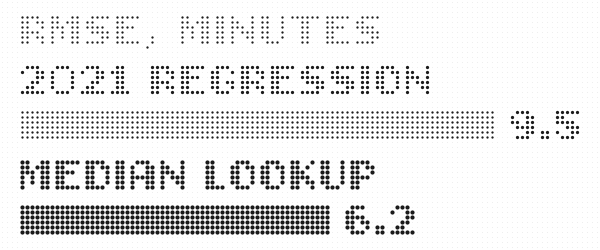
I rebuilt nineteen of my University of Melbourne assignments and re-checked them with methods I did not know as a student. The first surprise was a median lookup beating my 2021 regression by more than three minutes a trip.
The Case for the Deliberate Generalist
Why I built my career across seven technical domains on purpose, and why breadth held to a consistent method is a strategic choice rather than a lack of focus.